
Instrument details
The TIME Spectrometer
A cryogenic millimeter-wave instrument designed for intensity mapping of [CII] emission from the early universe.
Core technology
Grating Spectrometer
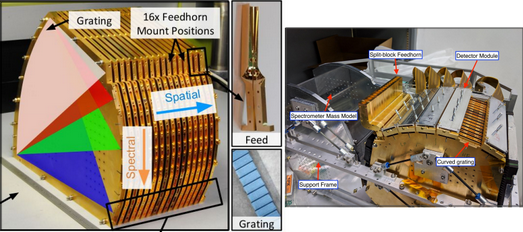
Diffraction gratings
TIME employs reflective diffraction gratings to disperse incoming millimeter-wave radiation into spectral channels. This allows simultaneous measurement of the [CII] line across a wide redshift range.
Frequency coverage
The spectrometer covers frequencies from ~ 180 - 320 GHz, corresponding to [CII] redshifts from z ≈ 5 to z ≈ 9. This range targets the epoch of reionization and cosmic dawn.
Resolution
With spectral resolution R ≈ 100, TIME can resolve individual [CII] lines while maintaining the wide field of view needed for intensity mapping.
Optical design
The instrument uses a compact, cryogenic optical design with off-axis mirrors and filters to minimize thermal emission and maximize throughput.
Detectors
Transition Edge Sensor Bolometers
TES arrays
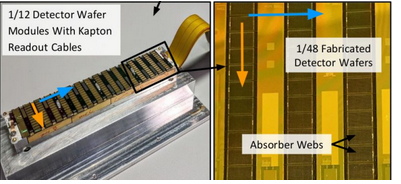
TES bolometers are superconducting thermistors operated at the sharp transition between the superconducting and normal states, typically at temperatures of ~0.3 K. Incoming mm-wave radiation is absorbed and converted into heat, producing a small change in temperature that leads to a measurable change in electrical resistance. TIME employs large, multiplexed arrays of TES bolometers comprising thousands of pixels.
Time-domain multiplexing
Detectors are read out using superconducting quantum interference devices (SQUIDs) in a time-domain multiplexing (TDM) scheme, in which signals from multiple detectors are sequentially sampled in time. Compared to frequency-domain multiplexing (FDM), TDM reduces readout complexity and wiring while maintaining low noise, enabling efficient readout of large TES arrays.
Background-limited performance
TES detectors achieve photon-noise-limited sensitivity, essential for detecting the faint [CII] signal against atmospheric and instrumental backgrounds.
Cryogenic cooling
A dilution refrigerator provides the ultra-low temperatures required, with multiple stages cooling optics, filters, and detectors to minimize thermal noise.
Platform
ARO 12-meter Telescope
Telescope specifications
The Arizona Radio Observatory’s 12-meter millimeter-wave telescope antenna has a surface accuracy of ~20 μm RMS, providing excellent beam quality at high frequencies.
Location
Located at Kitt Peak, Arizona, at 1,900 meters elevation, the site offers good atmospheric transmission in the millimeter band with PWV typically < 3 mm.
Mapping strategy
TIME will perform drift scans and raster mapping to cover large sky areas, building 3D tomographic maps of [CII] intensity.
Integration time
Typical integrations of 10-100 hours per field will achieve the sensitivity needed to detect the integrated [CII] signal from high-redshift galaxies.
Capabilities
Expected Performance
Sensitivity
TIME aims for a noise equivalent flux density (NEFD) of ~10-20 Jy/√Hz, enabling detection of [CII] intensities as low as 0.1 Jy/sr.
Field of view
The instrument has a field of view of ~1-2 degrees, allowing efficient mapping of large cosmological volumes.
System temperature
Owing to cryogenic cooling of the receiver, the system temperature is primarily limited by atmospheric and telescope emission, with typical values of 50 - 100 K, depending on frequency and observing conditions.
Calibration
Regular observations of calibrators (planets, bright quasars) and sky dips will ensure accurate flux calibration and atmospheric opacity monitoring.