Peering into the first billion years of galaxies
TIME
Tomographic Ionized-carbon Mapping Experiment
TIME maps the faint glow of ionized carbon in the early universe using cryogenic spectrometers on a precision millimeter telescope.
FAST FACTS
Uses line-intensity mapping of [CII] and CO emission to trace star formation and galaxy evolution from the Epoch of Reionization through cosmic noon.
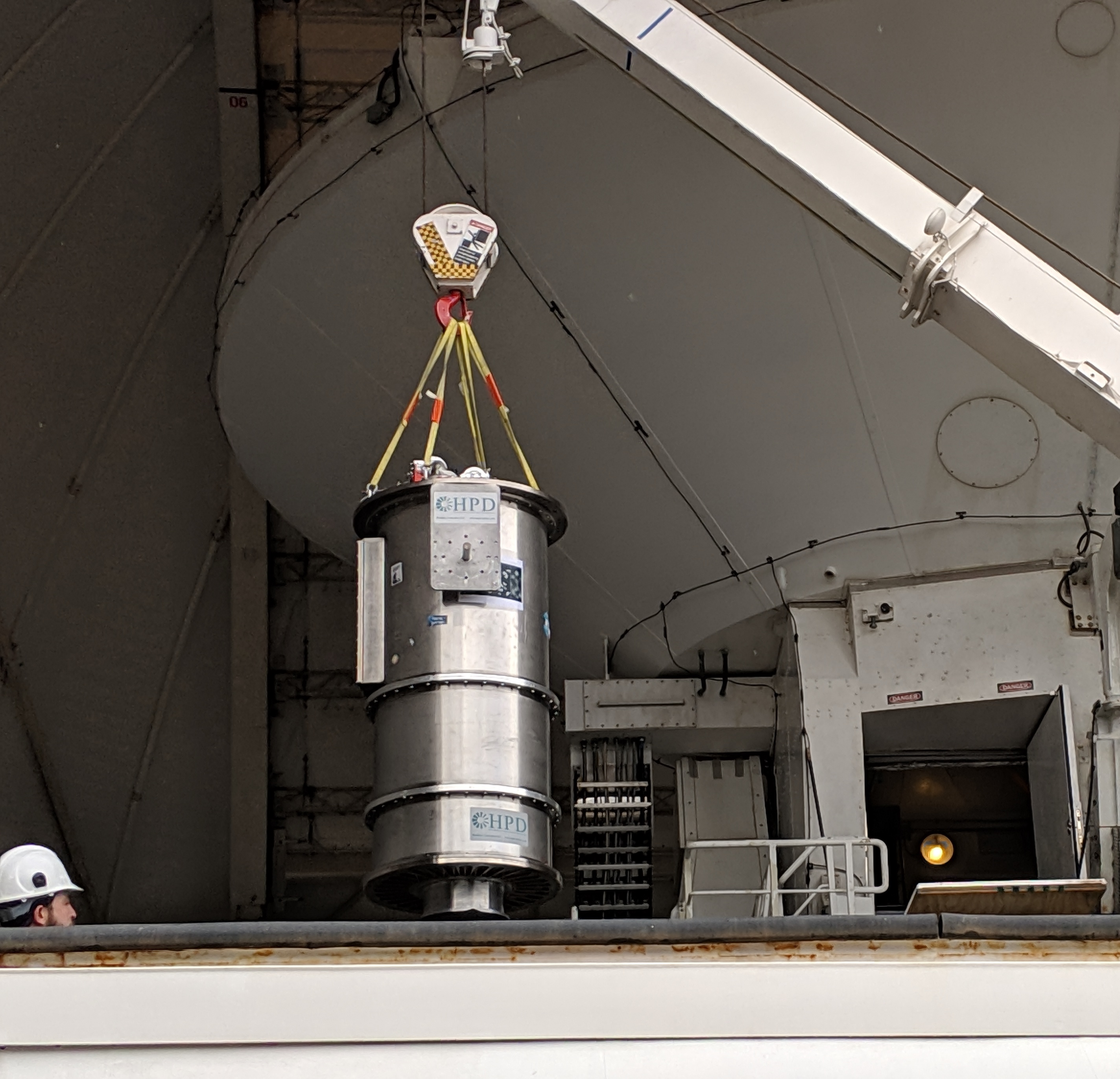
Closed-cycle cryostat with 4K–1K–300 mK stages and dual-stage 250/300 mK refrigerator for optimal performance.
32 independent grating spectrometers, each with 210 facets and a spectral resolving power of R ≈ 200 across the 186–324 GHz frequency range.
2-D arrays of transition edge sensor bolometers for background-limited sensitivity in detecting [CII] emission.
Science goals
What TIME will answer
When did stars light up?
Trace how quickly star formation rose after the Big Bang and how metals enriched the interstellar medium.
How did structure grow?
Compare intensity maps to simulations to understand how gas, dust, and dark matter evolved together during reionization.
Compare with observatories
TIME’s wide-field maps complement JWST and ALMA deep views, linking detailed galaxies to large-scale environments.
Secondary science
Measurements can constrain the Sunyaev–Zel’dovich effect in galaxy clusters and probe interstellar medium physics.
Why TIME
Mapping the growth of early galaxies
Intensity mapping
Instead of finding individual galaxies, TIME measures the integrated [CII] glow across wide sky areas. This reveals how star formation and metal enrichment progressed across cosmic time.
Cosmic dawn window
The redshifted 158 μm [CII] line arrives at millimeter wavelengths. TIME scans these bands to build three-dimensional tomographic maps of structure in the first billion years.
Hardware
The TIME Instrument
This section walks through the path of light and data through the instrument, from telescope to analysis.
ARO 12-m telescope → Optics & polarization → Spectral dispersion → Detection → Data
ARO 12-m telescope & optics
The telescope collects millimeter-wave light from the sky and delivers it through TIME's optics and polarization grid, which filter and polarize the incoming signal before coupling it into the spectrometers.
Grating spectrometers
Diffraction gratings disperse the broadband light into finely resolved frequency channels, enabling simultaneous spectral coverage across wide bands for efficient intensity mapping.
TES detectors & data
Superconducting transition edge sensors detect the dispersed spectra with high sensitivity, while data acquisition systems read out signals, calibrate them, and process them into usable astronomical data products.
Field notes
Using TIME in practice
How to use a FARO?
Learn how to operate the FARO laser scanner for precise alignment and calibration of the instrument components.
Go to the how-to page →What's the 'pipeline'?
Learn how we process raw data from the detectors into calibrated maps and scientific results.
Go to the science page →